Attribute Value Types in OpenUSD
A reference for all the built in attribute types.
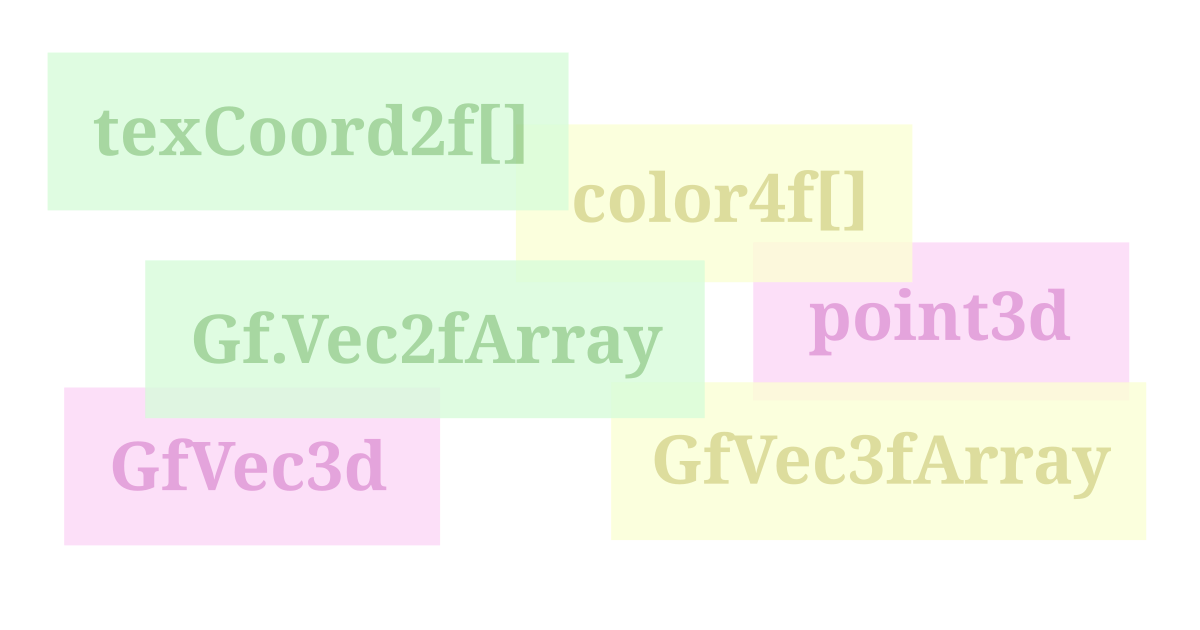
OpenUSD Prims have Attributes and Primvars (a type of attribute), which contain values for that prim. These values can be things like points for a Mesh, or a texture path for a Shader. The types for that data are specified by the schema. For instance, Mesh points are stored as a point3f[].
You can also store any arbitrary data you need in an Attribute. Recently I needed to figure out what types are available for Attributes. Like, what is everything they could represent?
The answer is not super simple, and not the easiest thing to find in the USD source, so I thought I'd write this up in case it helps someone, or most likely, me in the future. Hello future me and future readers. Be careful on those hoverboards. 🛹
Attribute Type Names
There are 3 different ways that attribute types are named in USD source code and USD files. They all refer to the same underlying data. The types of names are:
- C++/Python Source Code Type - For example,
GfVec2f/Gf.Vec2ffor a 2 value floating point pair - Value Type Name - Found in
SdfValueTypeNames/Sdf.ValueTypeNames, could beFloat2orTexCoord2f - usda text name - This is what you'll see in
usdafiles, could befloat2ortexCoord2f
Semantic Type Names
You'll notice that in Value Type Names we can refer to a 2 value float pair as a float2 or a texCoord2f. This is so we can provide a hint to readers as to the intended use for this 2 value float pair. I'll add Semantic Types sections to these tables to show all the possibilities for these.
Arrays
Most types can have an array form. In usda text this will add a [] to the type name, like float2[] or texCoord2f[]. The Value Type Name and source code names will have Array appended, like GfVec2fArray and Sdf.ValueTypeNames.TexCoord2fArray.
USD Attribute Types — Reference Table
Scalars
| usda | Sdf.ValueTypeNames | C++ type | notes |
|---|---|---|---|
bool |
Bool |
bool |
|
uchar |
UChar |
uint8_t |
Unsigned 8-bit. Useful for raw byte data |
int |
Int |
int32_t |
|
uint |
UInt |
uint32_t |
|
int64 |
Int64 |
int64_t |
|
uint64 |
UInt64 |
uint64_t |
|
half |
Half |
GfHalf |
16-bit float (IEEE 754) |
float |
Float |
float |
32-bit float |
double |
Double |
double |
64-bit float |
timecode |
TimeCode |
SdfTimeCode |
A time value, rescaled across layer offsets |
string |
String |
std::string |
Arbitrary UTF-8 string |
token |
Token |
TfToken |
Interned string. Prefer over string for enumerated values |
asset |
Asset |
SdfAssetPath |
A file path. USD resolves this through the asset resolver |
Vectors — Generic (no semantic meaning)
| usda | Sdf.ValueTypeNames | C++ type | memory layout | notes |
|---|---|---|---|---|
float2 |
Float2 |
GfVec2f |
2× float32 | |
float3 |
Float3 |
GfVec3f |
3× float32 | |
float4 |
Float4 |
GfVec4f |
4× float32 | |
double2 |
Double2 |
GfVec2d |
2× float64 | |
double3 |
Double3 |
GfVec3d |
3× float64 | |
double4 |
Double4 |
GfVec4d |
4× float64 | |
half2 |
Half2 |
GfVec2h |
2× float16 | |
half3 |
Half3 |
GfVec3h |
3× float16 | |
half4 |
Half4 |
GfVec4h |
4× float16 | |
int2 |
Int2 |
GfVec2i |
2× int32 | |
int3 |
Int3 |
GfVec3i |
3× int32 | |
int4 |
Int4 |
GfVec4i |
4× int32 |
Notable gap: No unsigned int vector types (GfVec2ui does not exist).
Matrices
| usda | Sdf.ValueTypeNames | C++ type | memory layout | notes |
|---|---|---|---|---|
matrix2d |
Matrix2d |
GfMatrix2d |
4× float64, row-major | |
matrix3d |
Matrix3d |
GfMatrix3d |
9× float64, row-major | |
matrix4d |
Matrix4d |
GfMatrix4d |
16× float64, row-major | The standard xform matrix in USD |
frame4d |
Frame4d |
GfMatrix4d |
16× float64, row-major | Alias for matrix4d; semantic hint for coordinate frames |
Note: All matrix types are double-precision only. There are no float32 matrix types.
Quaternions
| usda | Sdf ValueTypeName | C++ type | memory layout | notes |
|---|---|---|---|---|
quatd |
Quatd |
GfQuatd |
4× float64 | |
quatf |
Quatf |
GfQuatf |
4× float32 | |
quath |
Quath |
GfQuath |
4× float16 |
Semantic Types — Colors
| usda | Sdf.ValueTypeNames | C++ type | equivalent generic | notes |
|---|---|---|---|---|
color3f |
Color3f |
GfVec3f |
float3 |
RGB, 32-bit. Most common for shader inputs |
color3d |
Color3d |
GfVec3d |
double3 |
|
color3h |
Color3h |
GfVec3h |
half3 |
Common in EXR / HDR workflows |
color4f |
Color4f |
GfVec4f |
float4 |
RGBA |
color4d |
Color4d |
GfVec4d |
double4 |
|
color4h |
Color4h |
GfVec4h |
half4 |
Semantic Types — Geometry
| usda | Sdf.ValueTypeNames | C++ type | equivalent generic | transforms as |
|---|---|---|---|---|
point3f |
Point3f |
GfVec3f |
float3 |
position (w=1) |
point3d |
Point3d |
GfVec3d |
double3 |
position (w=1) |
point3h |
Point3h |
GfVec3h |
half3 |
position (w=1) |
normal3f |
Normal3f |
GfVec3f |
float3 |
|
normal3d |
Normal3d |
GfVec3d |
double3 |
|
normal3h |
Normal3h |
GfVec3h |
half3 |
|
vector3f |
Vector3f |
GfVec3f |
float3 |
direction (w=0) |
vector3d |
Vector3d |
GfVec3d |
double3 |
direction (w=0) |
vector3h |
Vector3h |
GfVec3h |
half3 |
direction (w=0) |
Note: No 2-component semantic vector types. For 2D directions, use float2 / Float2.
Semantic Types — Texture Coordinates
| usda | Sdf.ValueTypeNames | C++ type | equivalent generic | notes |
|---|---|---|---|---|
texCoord2f |
TexCoord2f |
GfVec2f |
float2 |
The standard UV primvar type |
texCoord2d |
TexCoord2d |
GfVec2d |
double2 |
|
texCoord2h |
TexCoord2h |
GfVec2h |
half2 |
|
texCoord3f |
TexCoord3f |
GfVec3f |
float3 |
UVW / projected coords |
texCoord3d |
TexCoord3d |
GfVec3d |
double3 |
|
texCoord3h |
TexCoord3h |
GfVec3h |
half3 |
Special / Uncommon Types
| usda | Sdf.ValueTypeNames | C++ type | notes |
|---|---|---|---|
pathExpression |
PathExpression |
SdfPathExpression |
Pattern matching for prim paths. Used in USD collections |
opaque |
Opaque |
SdfOpaqueValue |
A type with no value representation. Can't be serialized. |
group |
Group |
SdfOpaqueValue |
A type of opaque value |
How to enumerate this yourself
for x in dir(Sdf.ValueTypeNames):
    if not x.startswith('_') and x not in ('Find',):
        print(x, ":", getattr(Sdf.ValueTypeNames, x))
Note: Find appears in dir() output but is a method, not a type entry — filter it out.
What's not here
SdfPathdoes not appear inSdf.ValueTypeNames. Relationships handle storing prim paths, not Attributes. Relationships can update theSdfPathvalue when stages are composing, since composition can change the path to the prim theSdfPathrefers to.- Plugin-defined types can extend this list. These tables only have the built in types.